
Supported
There is observable consumer interest and specialist-builder activity. Conventional production building also demonstrates the value of repeatable plans and purchasing.
Neighborhood strategy · Research in progress
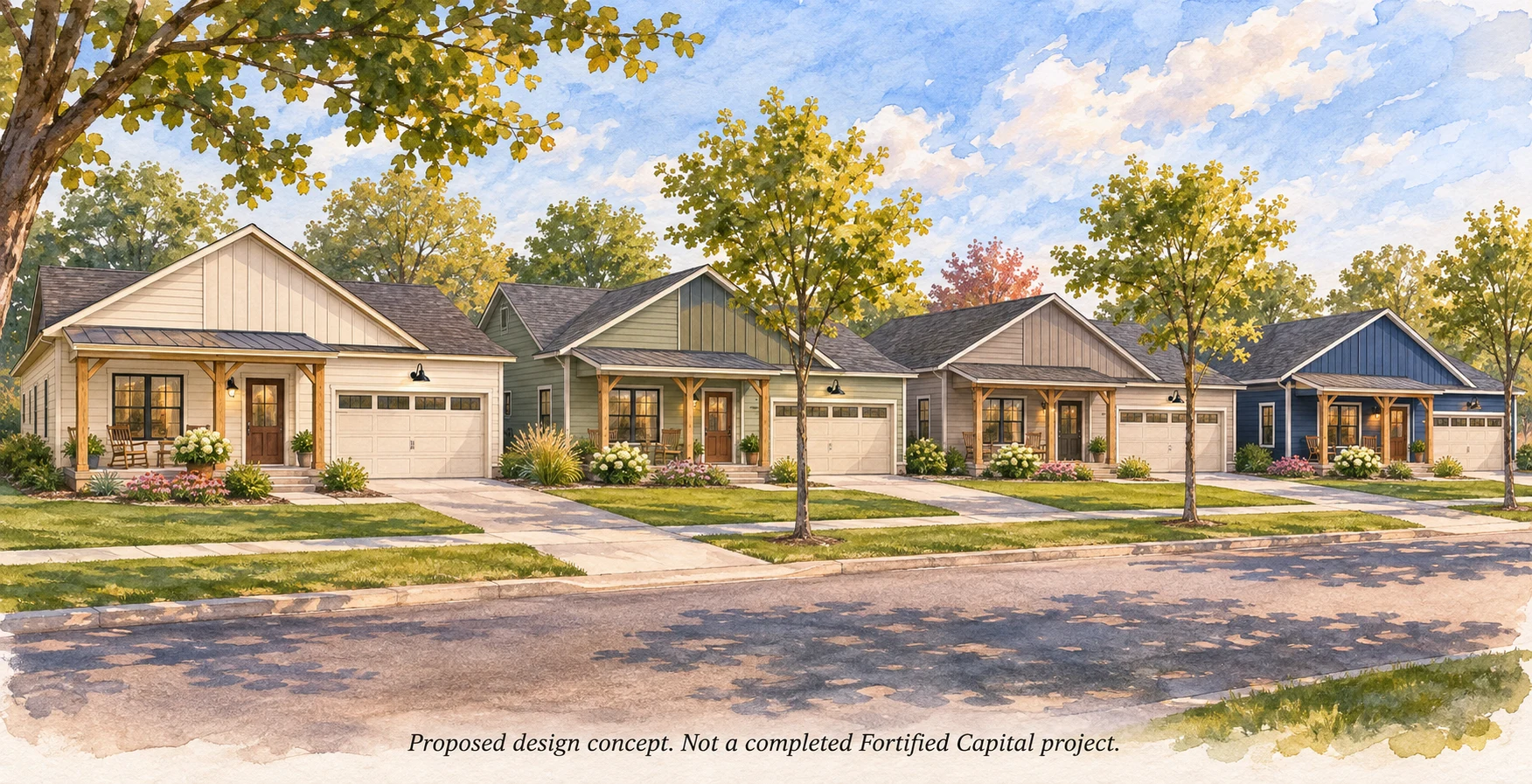
Practical homes. Repeatable construction. Places people want to live. We’re exploring what happens when barndominium-inspired design meets a thoughtfully planned residential neighborhood.
There is observable consumer interest and specialist-builder activity. Conventional production building also demonstrates the value of repeatable plans and purchasing.
Simpler geometry and coordinated production may improve execution. Finished-home savings depend on local bids, specifications, site conditions and the selected structural system.
Search activity does not establish local purchases, a resale premium, faster absorption or a profitable subdivision. A barndominium system has not been shown here to outperform equivalent conventional construction.
Our working conclusion: this is a product and development hypothesis worth testing in selected markets. Standardization may create more of the advantage than the barndominium label itself.
01 / The problem
Residential development has to reconcile the price a buyer can afford with land, construction, labor, infrastructure and financing costs. Conventional construction can succeed. Our question is where a different product and a more repeatable process could improve the fit.
The Census Bureau reports a $417,400 median sale price for new single-family homes sold in 2025, with a median size of 2,194 square feet. These national figures include all builder types and do not establish local affordability.[1]
02 / The opportunity
We look for agreement across consumer searches, housing-platform behavior and actual builder activity. Each signal answers a different question.
How to weigh this evidence: official housing data and original survey or platform research provide context; company histories document business activity; commercial keyword estimates are supplementary. None substitutes for local sales, appraisals and matched construction bids.
of surveyed single-family builders reported building a barndominium in the preceding year, February 2024 survey.[8]
Builder participationZillow identifies barndominium-related housing-search growth across Texas, Oklahoma, Missouri and Kentucky. It does not establish completed purchases.[6]
Housing-platform researchMilmar created a dedicated homes division to manage a growing number of post-frame homes, according to its history.[9]
Midwest company evidenceA published Google Trends analysis reports the following state scores for “barndominium,” April 23, 2025-April 23, 2026.[4]
Relative interest, not search counts or growth percentages. A state scoring 100 does not necessarily have the most total searches. Google normalizes by location and time.[3] We reviewed the published analysis; a fresh raw Google Trends export was not obtained.
Zillow’s original 2025 research reports growth in barndominium, pole-barn and acreage searches across Texas, Oklahoma, Missouri and Kentucky. It does not publish a barndominium-specific growth percentage or conversion to purchases.[6]
Stagingmate’s commercial U.S. study reports 4,108 monthly searches for “barndominium homes for sale,” September 2025-August 2026: down 26% from the prior year and 18% from its October 2022-September 2023 baseline.[7]
Different terms, periods, platforms and geographies cannot be added together. Broad curiosity can grow while purchase-oriented searches cool. Commercial search estimates were not independently validated.
Exploding Topics reports approximately 43% growth in “barndo” search volume from October 2024 through September 2026. Geography is unspecified and the estimate was not independently validated. It cannot establish U.S. buyer demand or be directly compared with the other time periods and keywords here.[5]
03 / The evolution
New specialists and established post-frame contractors are organizing around residential work. Below are documented examples, not a census of builders or an endorsement of their construction quality.
| Business / market | Documented milestone | What it shows |
|---|---|---|
| Milmar HomesIndiana / Midwest | 2023 residential division | Company ties its homes division to growing post-frame residential work.[9] |
| The Barndo Co.SC / NC / TN | Founded 2021; six listed locations | Specialist multistate presence; public annual delivery volume is not established.[10] |
| Midsouth BarndominiumsTennessee | Founded 2021 | In-house blueprint and interior design, plus turnkey construction.[11] |
| House to Home BuildersNortheastern Oklahoma | Founded 2024 | Recent entrant advertising barndominiums alongside conventional custom homes.[12] |
| Back Forty / MR Post FrameMultistate design network | 2020 launches; 2024 design merger | Organized design, education and builder support; not a count of finished homes.[13] |
| The Barndominium CompanyTexas / design services | Opened July 2020 | Specialist design, build and decor services. Distinct from The Barndo Co.[14] |
| FBi BuildingsIndiana / regional construction | Current dedicated offering | Shell construction, Back Forty floor plans and First Federal-powered financing partnership.[15] |
Founding dates and service histories are primarily company-reported. New brands, locations and divisions do not establish national net business growth, profitability or demand exceeding supply.
04 / The vision
Front porches. Familiar streets. Useful spaces. A coordinated place to call home.
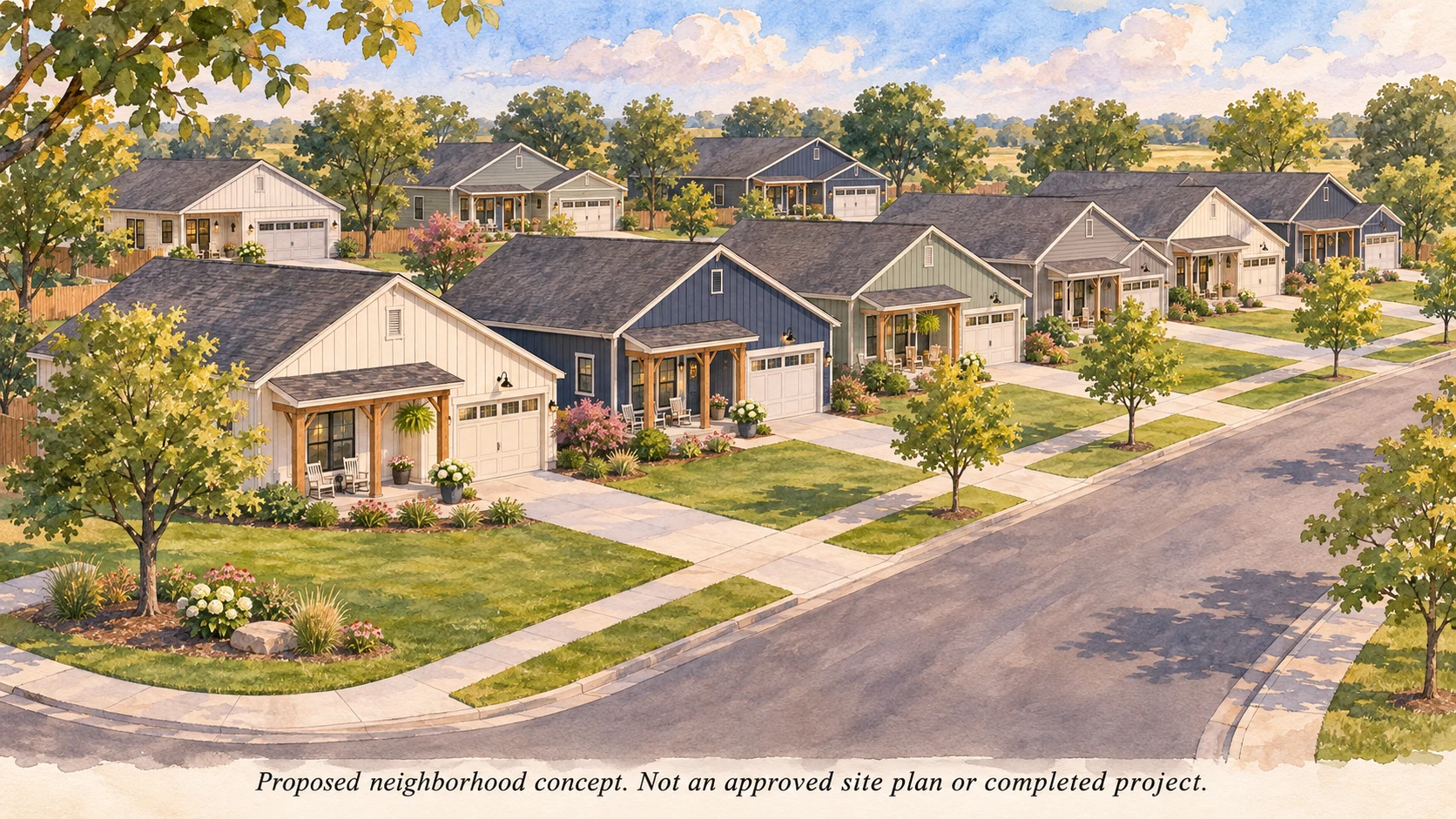
Our concept brings practical barndominium design principles to permanent residences on conventional residential lots. A limited family of floor plans could share construction details while varying porch treatments, color, landscaping and garage placement.
The proposed neighborhood should feel residential and welcoming: everyday family layouts, balanced streetscapes, sidewalks where appropriate, and infrastructure designed for the community.
Whether a buyer needs an ordinary garage or a larger hobby space is a market question. A large workshop is not assumed to be necessary in every home.
A market example / Hallsville, Texas
A listing identifies a new 1845 Barndominiums home with 1,500 living square feet, three bedrooms and two bathrooms on a 6,403-square-foot lot, about 0.147 acre. It describes a new neighborhood within city limits and city utilities.[16]
The record reports an October 20, 2026 closing. The sale price is undisclosed. The initial $289,000 asking price was reduced to $280,000; neither is treated as the closing price.
This is a third-party example, not a Fortified project. One closing illustrates neighborhood compatibility; it does not prove fast absorption, subdivision profitability or the framing system.
05 / The competitive question
“Barndominium” can describe a style, a home-and-shop arrangement, or several framing methods. NAHB found that 70% of participating barndominium builders described residential space combined with a large shop; smaller groups identified post-frame or hybrid systems.[8] We evaluate the actual assembly and specifications.
| Approach | Potential benefit to test | Challenge to resolve |
|---|---|---|
| Custom barndominium | Tailored living, garage and shop arrangement. | One-off design and selections can limit repeatability. Verify appraisal comparables and full scope. |
| Standardized production barndominium | Repeat plans and details; test post-frame, structural steel or hybrid assemblies where appropriate. | Engineering, local trades, envelope details, financing and residential market acceptance. |
| Standardized conventional wood frame | Apply the same simpler geometry, specifications and scheduling discipline. | Must receive an equal opportunity to compete on finished-home cost and performance. |
| Conventional production subdivision | Established delivery model with potential purchasing and scheduling scale. | Compare equivalent lot development, features, selling costs and financial exposure. |
Repeatable plans, clear subcontractor scopes, consistent materials and quality checks are operating mechanisms available to multiple construction systems.
Any claimed material, labor or scheduling benefit must be demonstrated through equivalent engineered designs and complete local bids.
A recognizable style may differentiate the product. Attractive architecture can be paired with different structural systems.
06 / The economics & risks
Home-shell savings, if achieved, must survive the full cost of delivering a finished neighborhood: land, entitlement, engineering, roads, drainage, utilities, lot preparation, complete homes, financing, carrying costs, marketing, commissions, contingencies and compensation.
A five-home program may spread design work across several units. Ten or twenty-five homes may offer more purchasing continuity, but also require more capital, infrastructure and selling time. A single custom project has a different risk profile.
Before choosing a scale, we would compare favorable, base and unfavorable cases using actual parcel costs, complete builder bids, financing terms and supported sale prices. No project forecast or investment return is established on this page.
A DFW appraisal study analyzed 139 barndominium closings. Its within-subdivision price estimate was +6.8%, with a confidence interval of −0.2% to +14.2%, which does not establish a reliable premium.[17]
The author also reported 53.4% of resolved barndominium listings cancelled or expired, versus 28.3% of others. That is a listing outcome, not proof the properties never sold later. This regional author study uses MLS classifications, not independently verified framing.
Search interest may not convert into purchases. Limited comparable sales and slower absorption can constrain prices and financing.
Zoning, setbacks, exterior standards, soils, drainage and utility capacity must fit the actual site.
Overruns, subcontractor capacity, debt terms, interest carry and delayed closings can erase expected margins.
Performance / What we can substantiate
A Metal Construction Association study projected more than 60 years of service for a specific low-slope, unpainted aluminum-zinc-coated standing-seam roof system under stated conditions. It examined 14 roofs with up to 35 years of service.[18]
That projection is not a claim for every residential metal roof. Components, inspection and maintenance matter. Conventional homes can use the same roofing system.
We have not established lower utility bills or total ownership costs for barndominiums as a category. Comparable energy modeling, air-leakage tests, insulation details, HVAC design, insurance quotes and maintenance requirements are needed.
A metal exterior, radiant floor or spray foam specification alone is not a verified household savings figure.
07 / The Fortified Capital approach
Residential demand + efficient construction + standardized production + thoughtful neighborhood development.
Fortified Buildings’ construction experience can help inform questions about materials, scope, scheduling and execution. That practical knowledge supports investigation; it does not guarantee profitable development or investment outcomes.
We’re interested in projects where the evidence supports the model, with a clear view of why it might not work.
Research notes / Updated November 13, 2026
Original research, public company information and attributed commercial analyses are identified below. Company statements are not independently audited. Search metrics measure interest, not qualified buyers. No national barndominium sales average, construction-cost advantage or return forecast is claimed.
National housing context; all builder types. Sale prices include land; construction contracts are different measures.
Analysis of 2025 construction data. Contract prices exclude improved lots. Not a matched comparison of construction systems.
Relative search interest is normalized from 0 to 100. It is not a buyer count or a poll.
Commercial supplier analysis; reported state scores cover April 23, 2025-April 23, 2026. Raw Google export was not independently obtained for this page.
Provider reports approximately 43% growth, October 2024-September 2026. Geography is not established as U.S.-only; estimates are not unique buyers.
Original platform research; regional search direction, without published barndominium-specific growth percentages or purchase conversion.
Commercial U.S. keyword study; narrower homes-for-sale phrase. Underlying keyword collection was not independently validated.
Builder participation in the preceding 12 months. Not share of homes sold or a growth-rate measurement.
Company reports establishing a homes division in 2023 in response to growing post-frame residential activity. No audited annual unit series.
Six listed locations across SC, NC and TN. Founding in 2021 is reported in its company-provided Inc. profile: https://www.inc.com/profile/the-barndo-co . No national market-share inference.
Company reports founding in 2021 and development of in-house design and turnkey services.
Company reports founding in 2024 and advertising barndominiums alongside custom homes. Completed volume is not established.
Company reports 2020 launches and a 2024 merger of design operations. Design services are distinct from completed residences.
Company reports opening in July 2020 and a specialist design/build/decor team. Not the same business as The Barndo Co.
Shell builder; identifies Back Forty design and First Federal-powered lending partnerships. Credit and geographic conditions apply.
Reported October 20, 2026 closing; sale price undisclosed. Listing identifies builder and neighborhood characteristics; framing is not independently verified.
Regional author analysis of MLS classifications; not a national, independently audited, or framing-verified study.
Industry-sponsored study of a particular standing-seam system. Projected life is not a warranty or a claim for all residential metal roofs.
My real estate investment-management business evaluates projects, structures participation through specific offerings, and oversees investment decisions and reporting. It has a residential development focus.
My separate construction business brings practical experience with materials, budgets, subcontractors and schedules. Construction work is a separate commercial service. That experience does not establish a fund’s investment performance.
If an affiliated business is engaged on an investment project, ask for its scope, contract, compensation and conflict disclosures. Investor interests, manager fees and construction payments are different things.
The business plan, local demand, property and construction assumptions, financing, downside scenarios and exit options.
Who makes decisions, who approves related-party work, every fee and reimbursement, and how remaining cash is allocated.
The governing documents’ reporting commitments, available financial information and tax reporting. A reporting period is not a promised distribution date.
Our fund materials describe periodic financial-status reporting and annual financial and tax information. Ask for the current reporting schedule and a sample report before investing. Projected results and construction photographs are not a verified investor track record.